Planting calendar
Zone 7 Planting Calendar (7a & 7b): Printable, by Month
Last updated September 14, 2026
Zone 7 runs winter lows of 0 to 10°F, and is conventionally taken to average its last spring frost around April 5 and its first fall frost around November 1 — about 210 frost-free days. Seven months frost-free. Mid-summer heat, not frost, becomes the limiting factor for lettuce and spinach.
Sow frost-tolerant crops (peas, spinach, radishes, lettuce, kale, carrots) 6 to 2 weeks before April 5. Plant warm-season crops (beans, zucchini, cucumbers, tomatoes, peppers) 1 to 3 weeks after it. Sow a second round of greens and roots about 10 to 12 weeks before November 1.
Typical regions in zone 7: New York City, Boston, St. Louis, Nashville, Oklahoma City, Salt Lake City and much of Virginia and Tennessee.
Zone 7 planting chart
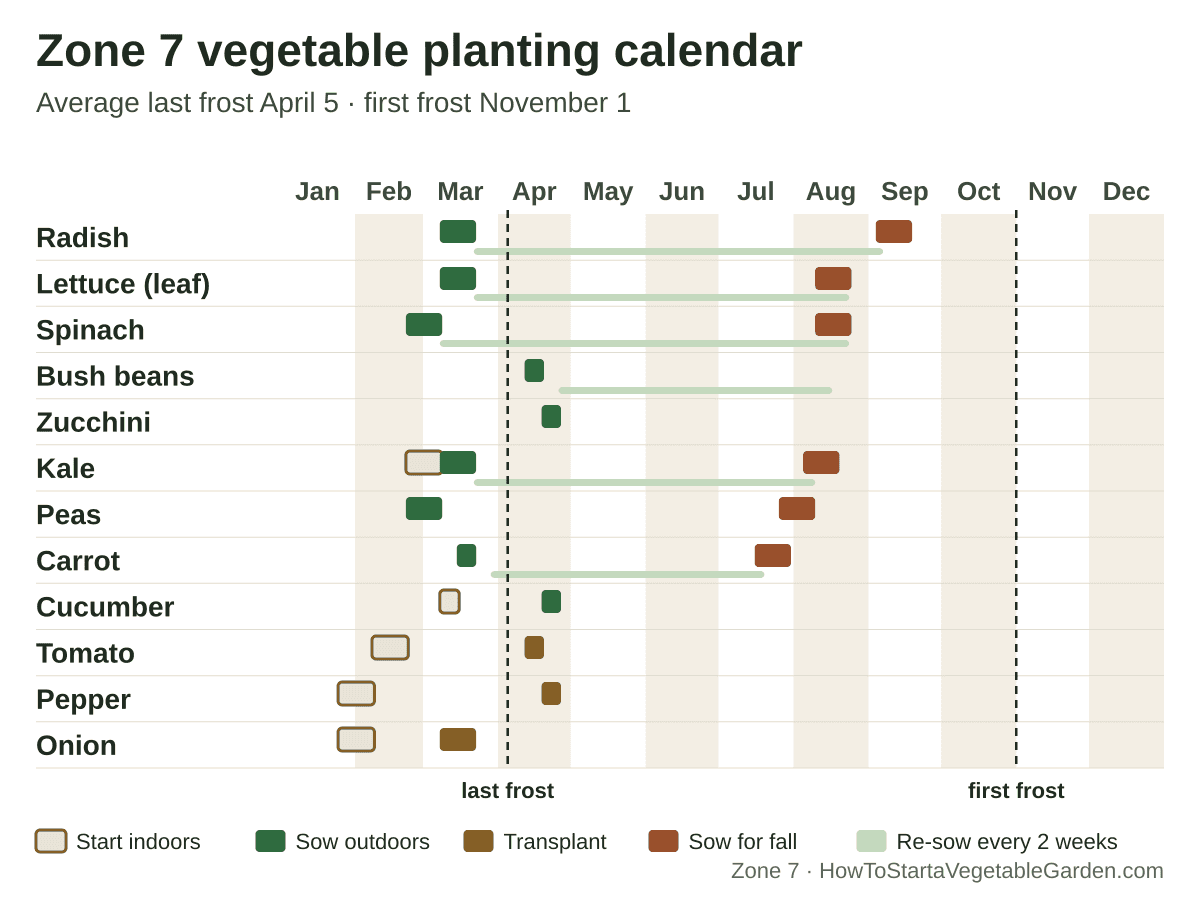
Month by month in zone 7
9 of the 12 months have something to plant in zone 7. Rows marked re-sow are succession sowings — the same crop planted again every 14 days for a continuous harvest, up to the last date it can still mature before November 1.
January
| Crop | What to do | Window |
|---|---|---|
| Onion | Start indoors | January 25 - February 8 |
| Pepper | Start indoors | January 25 - February 8 |
February
| Crop | What to do | Window |
|---|---|---|
| Kale | Start indoors | February 22 - March 8 |
| Onion | Start indoors | January 25 - February 8 |
| Pepper | Start indoors | January 25 - February 8 |
| Tomato | Start indoors | February 8 - February 22 |
| Peas | Direct sow outdoors | February 22 - March 8 |
| Spinach | Direct sow outdoors | February 22 - March 8 |
March
| Crop | What to do | Window |
|---|---|---|
| Cucumber | Start indoors | March 8 - March 15 |
| Kale | Start indoors | February 22 - March 8 |
| Carrot | Direct sow outdoors | March 15 - March 22 |
| Kale | Direct sow outdoors | March 8 - March 22 |
| Lettuce (leaf) | Direct sow outdoors | March 8 - March 22 |
| Peas | Direct sow outdoors | February 22 - March 8 |
| Radish | Direct sow outdoors | March 8 - March 22 |
| Spinach | Direct sow outdoors | February 22 - March 8 |
| Onion | Transplant outdoors | March 8 - March 22 |
| Carrot | Re-sow every 14 days | last sowing July 30 |
| Kale | Re-sow every 14 days | last sowing August 19 |
| Lettuce (leaf) | Re-sow every 14 days | last sowing August 24 |
| Radish | Re-sow every 14 days | last sowing September 18 |
| Spinach | Re-sow every 14 days | last sowing August 24 |
April
| Crop | What to do | Window |
|---|---|---|
| Bush beans | Direct sow outdoors | April 12 - April 19 |
| Cucumber | Direct sow outdoors | April 19 - April 26 |
| Zucchini | Direct sow outdoors | April 19 - April 26 |
| Pepper | Transplant outdoors | April 19 - April 26 |
| Tomato | Transplant outdoors | April 12 - April 19 |
| Bush beans | Re-sow every 14 days | last sowing August 19 |
| Carrot | Re-sow every 14 days | last sowing July 30 |
| Kale | Re-sow every 14 days | last sowing August 19 |
| Lettuce (leaf) | Re-sow every 14 days | last sowing August 24 |
| Radish | Re-sow every 14 days | last sowing September 18 |
| Spinach | Re-sow every 14 days | last sowing August 24 |
May
| Crop | What to do | Window |
|---|---|---|
| Bush beans | Re-sow every 14 days | last sowing August 19 |
| Carrot | Re-sow every 14 days | last sowing July 30 |
| Kale | Re-sow every 14 days | last sowing August 19 |
| Lettuce (leaf) | Re-sow every 14 days | last sowing August 24 |
| Radish | Re-sow every 14 days | last sowing September 18 |
| Spinach | Re-sow every 14 days | last sowing August 24 |
June
| Crop | What to do | Window |
|---|---|---|
| Bush beans | Re-sow every 14 days | last sowing August 19 |
| Carrot | Re-sow every 14 days may bolt in heat | last sowing July 30 |
| Kale | Re-sow every 14 days may bolt in heat | last sowing August 19 |
| Lettuce (leaf) | Re-sow every 14 days may bolt in heat | last sowing August 24 |
| Radish | Re-sow every 14 days may bolt in heat | last sowing September 18 |
| Spinach | Re-sow every 14 days may bolt in heat | last sowing August 24 |
July
| Crop | What to do | Window |
|---|---|---|
| Carrot | Direct sow for a fall crop | July 16 - July 30 |
| Peas | Direct sow for a fall crop | July 26 - August 9 |
| Bush beans | Re-sow every 14 days | last sowing August 19 |
| Carrot | Re-sow every 14 days may bolt in heat | last sowing July 30 |
| Kale | Re-sow every 14 days may bolt in heat | last sowing August 19 |
| Lettuce (leaf) | Re-sow every 14 days may bolt in heat | last sowing August 24 |
| Radish | Re-sow every 14 days may bolt in heat | last sowing September 18 |
| Spinach | Re-sow every 14 days may bolt in heat | last sowing August 24 |
August
| Crop | What to do | Window |
|---|---|---|
| Kale | Direct sow for a fall crop | August 5 - August 19 |
| Lettuce (leaf) | Direct sow for a fall crop | August 10 - August 24 |
| Peas | Direct sow for a fall crop | July 26 - August 9 |
| Spinach | Direct sow for a fall crop | August 10 - August 24 |
| Bush beans | Re-sow every 14 days | last sowing August 19 |
| Kale | Re-sow every 14 days may bolt in heat | last sowing August 19 |
| Lettuce (leaf) | Re-sow every 14 days may bolt in heat | last sowing August 24 |
| Radish | Re-sow every 14 days may bolt in heat | last sowing September 18 |
| Spinach | Re-sow every 14 days may bolt in heat | last sowing August 24 |
September
| Crop | What to do | Window |
|---|---|---|
| Radish | Direct sow for a fall crop | September 4 - September 18 |
| Radish | Re-sow every 14 days | last sowing September 18 |
October
Nothing to sow outdoors in October in zone 7. Crops already in the ground keep growing and keep being harvested.
November
Nothing to sow outdoors in November in zone 7. Crops already in the ground keep growing and keep being harvested.
December
Nothing to sow outdoors in December in zone 7. Crops already in the ground keep growing and keep being harvested.
Nothing to sow outdoors in October, November, December in zone 7. Use the time to plan beds, order seed, build a compost pile, or start long-season crops under a light indoors.
Every crop, sowing to harvest
One row per crop, with the indoor start where it applies, the outdoor planting window, the second fall sowing where the season allows it, and the earliest realistic harvest.
| Crop | Start indoors | Plant outdoors | Fall sowing | Re-sow until | Harvest from |
|---|---|---|---|---|---|
| Radish | - | Direct sow outdoors: March 8 - March 22 | September 4 - September 18 | September 18 | March 30 - April 7 |
| Lettuce (leaf) | - | Direct sow outdoors: March 8 - March 22 | August 10 - August 24 | August 24 | April 17 - May 2 |
| Spinach | - | Direct sow outdoors: February 22 - March 8 | August 10 - August 24 | August 24 | April 8 - April 18 |
| Bush beans | - | Direct sow outdoors: April 12 - April 19 | - | August 19 | June 1 - June 11 |
| Zucchini | - | Direct sow outdoors: April 19 - April 26 | - | - | June 8 - June 18 |
| Kale | February 22 - March 8 | Direct sow outdoors: March 8 - March 22 | August 5 - August 19 | August 19 | April 22 - May 7 |
| Peas | - | Direct sow outdoors: February 22 - March 8 | July 26 - August 9 | - | April 18 - May 3 |
| Carrot | - | Direct sow outdoors: March 15 - March 22 | July 16 - July 30 | July 30 | May 24 - June 3 |
| Cucumber | March 8 - March 15 | Direct sow outdoors: April 19 - April 26 | - | - | June 13 - June 28 |
| Tomato | February 8 - February 22 | Transplant outdoors: April 12 - April 19 | - | - | June 16 - July 6 |
| Pepper | January 25 - February 8 | Transplant outdoors: April 19 - April 26 | - | - | June 28 - July 18 |
| Onion | January 25 - February 8 | Transplant outdoors: March 8 - March 22 | - | - | June 16 - July 6 |
Zone 7a vs 7b: what the letter means
Zone 7 covers places whose coldest night of the year averages 0 to 10°F. USDA splits it into two 5-degree halves: 7a (0 to 5°F) and 7b (5 to 10°F).
The letter tells you about winter survival — whether a perennial left in the ground makes it through the coldest night. It says nothing about when your last spring frost arrives, and that date decides every sowing window on this page. New York (LaGuardia), NY (7b) and Salt Lake City, UT (7b) are both zone 7, yet their typical last frosts are 13 days apart: Mar 26 and Apr 8.
So for vegetables, ignore the letter. Find the frost dates for the weather station nearest you — the table below covers 6 zone 7 cities — and enter them in the interactive calendar. Every window recalculates from your dates.
Frost dates for cities in zone 7
Same zone, frost dates weeks apart — which is why the calendar asks for your own dates rather than trusting the zone.
| City | Zone | Last frost | 30% | 10% | First frost | 30% | 10% | Frost-free days |
|---|---|---|---|---|---|---|---|---|
| New York (LaGuardia), NY new york laguardia ap Use these dates | 7b | Mar 26 | Apr 1 | Apr 6 | Nov 25 | Nov 17 | Nov 10 | 244 |
| Boston, MA boston logan intl ap Use these dates | 7a | Apr 4 | Apr 8 | Apr 17 | Nov 9 | Nov 3 | Oct 29 | 218 |
| St. Louis, MO st louis lambert intl ap Use these dates | 7a | Apr 2 | Apr 7 | Apr 17 | Nov 4 | Oct 30 | Oct 23 | 215 |
| Nashville, TN nashville intl ap Use these dates | 7b | Mar 31 | Apr 6 | Apr 16 | Nov 3 | Oct 30 | Oct 22 | 217 |
| Oklahoma City, OK oklahoma city will rogers ap Use these dates | 7b | Apr 4 | Apr 10 | Apr 20 | Nov 2 | Oct 29 | Oct 21 | 213 |
| Salt Lake City, UT salt lake city intl ap Use these dates | 7b | Apr 8 | Apr 16 | Apr 30 | Oct 31 | Oct 25 | Oct 17 | 204 |
Sources: NOAA NCEI U.S. Climate Normals 1991-2020, annual/seasonal ; USDA Plant Hardiness Zone Map 2023 (PRISM Climate Group, Oregon State University) . The zone shown is read from the 2023 USDA map at each station's location.
Growing in zone 7
Seven months frost-free. Mid-summer heat, not frost, becomes the limiting factor for lettuce and spinach.
Soil beats calendar. Extension guidance for the hardiest crops is “as soon as the soil can be worked” or “as soon as the soil thaws” — not a fixed date. If you cannot crumble a handful of soil in your fist, wait, whatever the table says. Warm-season crops have a matching rule: beans want 60°F soil, cucumbers and squash 70°F.
About the bolting warnings. Cool-season crops run to seed and turn bitter in summer heat. The “may bolt in heat” flag above is a rough calendar rule — mid-June to the start of September, the same window across the whole country — because a hardiness zone carries no summer-temperature information at all. In zone 7 treat it as about right, with heat-tolerant varieties and afternoon shade extending it either side.
Where these dates come from. A USDA hardiness zone describes average annual extreme minimum WINTER temperature — it is a winter-survival rating for perennials, not a frost-date band. The frost dates below are widely-used approximations for each zone, not official USDA figures, and a single zone spans hundreds of miles. Treat them as a default guess and replace them with your own local averages wherever you have them.
You can enter your own frost dates in the interactive calendar and every window on it recalculates from your numbers. Look up your local averages on the NOAA last-spring-freeze map. Note that an “average” frost date is the point where the chance of freezing drops below 50 percent, so for tender crops it is worth waiting a week or two past it.
Other zones: zone 3 , zone 4 , zone 5 , zone 6 , zone 8 , zone 9 , zone 10 . Or use the interactive calendar to check a single month.
Zone 7 questions
When is the last frost in zone 7?
Zone 7 is conventionally taken to average its last spring frost around April 5 and its first fall frost around November 1, giving roughly 210 frost-free days. Be aware that a hardiness zone is defined by winter minimum temperature, not by frost dates — these are widely-used approximations, not official USDA figures. Get your real dates from the NOAA freeze-date map or your county cooperative extension office.
What can I plant now in zone 7?
Use the month-by-month table on this page. The pattern is: frost-tolerant crops like peas, spinach and radishes go in 6 to 2 weeks before April 5; warm-season crops like beans, zucchini and tomatoes go in 1 to 3 weeks after it; and cool-season crops get a second sowing about 10 to 12 weeks before November 1.
Can I grow tomatoes in zone 7?
Yes. In zone 7, start tomato seed indoors 6 to 8 weeks before April 5 or buy a seedling, then transplant 1 to 2 weeks after the last frost once nights stay above 50°F. With 210 frost-free days there is comfortable room for any variety, including large beefsteak types.
How many harvests can I get in zone 7?
Two full rounds: a spring planting of cool-season crops, a summer planting of warm-season crops, and a fall sowing of greens and roots in the same beds.
Does a raised bed change these dates in zone 7?
Yes, in spring. A raised bed warms 2 to 3 weeks earlier than open ground, so you can bring the early sowings forward by up to two weeks. Autumn dates are unchanged, since the first frost arrives on the same day regardless of your setup.
What is the difference between zone 7a and 7b?
Five degrees in the average coldest night of the year. Zone 7a averages 0 to 5°F at its coldest and zone 7b 5 to 10°F. The letter matters for perennials on the edge of winter hardiness. It does not change vegetable planting dates, which follow your frost dates — the calendar on this page applies to both halves.
Is zone 7a or 7b better for tomatoes?
Neither — the letter does not decide it. 7a and 7b differ only in how cold the coldest winter night gets, and tomatoes grow in summer, long after that night has passed. What matters is the length of your frost-free season. Within zone 7, New York (LaGuardia), NY (7b) averages 244 frost-free days and Salt Lake City, UT (7b) only 204. Check the city table on this page, or enter your own frost dates in the calendar.
What can I plant in July in zone 7?
In zone 7, July plantings are: sow for a fall crop — carrot and peas; re-sow every 14 days — bush beans, carrot, kale, lettuce (leaf), radish and spinach. The July table gives the exact window for each. Cool-season sowings in July may bolt in the heat.
When does fall planting start in zone 7?
Sowings for a fall harvest in zone 7 start around July 16 with carrot and run to about September 18 with radish. Each date is counted back from the average first frost (November 1) by the crop's days to harvest plus two weeks, so a crop sown on time matures before the cold arrives.
Is there a printable PDF of the zone 7 planting calendar?
Not as a download yet. The chart and the month-by-month tables on this page print cleanly — use your browser's Print command and the menus, ads and questions are left off the page. A downloadable version is on the way.
Keep going
The 10 easiest vegetables for beginners
Ranked by how hard they are to kill, with days to harvest for each.
Raised beds vs containers vs in-ground
Cost, effort and yield compared, so you can pick a setup in one sitting.
Starting seeds indoors
What you actually need, the timeline that works, and how to harden off.